Sunday, June 28, 2020

Making a simple fence system

I needed to make a simple fence system for a new bench top I made. Some time ago I incorporated an MFT-style top into a bench in my workshop. This is a bench top with 20mm holes set in a 96mm pattern over the surface. It allows precise 90, 45, 30 & 60 deg cuts to be made and the square up assemblies and a whole host of other things. It's quite the versatile bench system.

In the process of cutting some MDF for a project I had a rather large piece of 18mm left over, so I trimmed it to what I thought was a manageable size of 1800x900mm (turned out still to be rather heavy to carry around so not as 'portable' as I thought) and set about drilling it out in the 96mm pattern. I used the Parf Guide system and after a couple of hours I had a nice series of holes across the surface.


I toyed with a few ideas for making a fence and in the end decided to use some aluminium extrusion. I'd used the same type of thing on the bench in the workshop. The question was did I buy some more of the fence-dogs for this fence or did I use the ones I already had-simply moving them from one been to the other-or did I make something new?

Something new won the argument in my head so I made a prototype anchor that held the aluminium against a bench dog. I also made a simple sliding stop using MDF and some M5 track nuts and screw knobs.


These worked quite well. They held the extrusion in place, pulling it firmly against the bench dog and it was nice and square to the rest of the bench. The only problem was that using MDF in this way to make the clams was not the best option. They just felt flimsy and I thought there must be a better solution. 

Then I remembered the 3D printer and got to work designing the parts for 3D printing.

The end result is an effective clamping system and a smooth operating stop. I've drilled a couple of 20mm holes in my bench that houses my mitre saw so the fence can used there too.

All in all I'm very pleased with the end result. 

I swapped the hex head bolts for some with hex sockets.

Monday, April 13, 2020

Extract from The Guardian-April 13th 2020

I extracted this from The Guardian so that I had a record of these things. It is copied as it appeared on the web version of the paper. I am grateful for the independent journalistic voice of the paper.

Epidemiologists and public health experts are divided over how effective the government’s response has been but criticism has been increasing in recent weeks as the UK death toll rises.
Sue Hill, vice-president of the Royal College of Surgeons, said she believed UK deaths could rise to 30,000. She acknowledged that the government has a difficult job but said it gave the appearance of placing “political spin” over action.
Describing the daily Downing Street briefing as “a bit of a joke”, she said: “He [Boris Johnson or another cabinet minister] is sitting there speaking about subjects he doesn’t really understand and can’t answer questions about it. It’s political spin, isn’t it? They’re not doing themselves any favours.
“The thing that irritates me is cabinet ministers are standing up every day, addressing us as if we’re on a war footing and giving Churchillian quotes when they could be doing a few simple things like getting more bits of plastic and paper [which personal protective equipment is made out of] on to wards.”
Prof John Ashton, a former regional director of public health for north-west England, who has previously criticised the government over the crisis, said its performance had worsened.
He said: “It was the failure to convene [the emergency committee] Cobra at the beginning of February that meant everything else flowed from it, the failure to order equipment etc. Now we are into the cover-up. Any journalist worth their salt should boycott this propaganda [the daily briefing]. They don’t answer any questions.
“The chief nurse deflected the question about the number of nurses and doctors who died because of confidentiality. She wasn’t being asked about individuals, she was being asked about numbers.”
He also said that people were dying in care homes and at home without being tested while some were being sent home to die before they had been tested.
“There are probably large numbers of people who are not being counted,” said Ashton.
Dave Prentis, general secretary of Unison, said “the time for excuses has passed” when it came to PPE failures and the deaths of medical and care staff.
“Ministers have been saying for weeks that the PPE situation is in hand. That there’s enough to go around and it’s just a matter of logistics. But it isn’t good enough,” he said.
“NHS, care and other key workers are falling ill in huge numbers. Some have already died – including nurses, doctors, care workers, healthcare assistants and porters.”
Unison said its PPE alert hotline has been told of care workers being told to wash their face masks for reuse, threatened with the sack for using them, having to buy their own stock and having to use watered down handwash.
Labour has tried to strike a constructive tone when criticising the government, but Sir Keir Starmer warned of a “mismatch” between the complaints of medical and care staff that they lack protective equipment and ministers insisting there is enough to go round. The new Labour leader is also expected to press the government this week on gaps in the UK’s financial support schemes for workers and businesses.
Andy Burnham, Labour’s last health secretary, said: “The issue is not whether mistakes will be made, the question is how quickly do you acknowledge them and correct them. I think on certain issues they have done that but on what’s most material – PPE - they haven’t.”
Meanwhile, Labour backbenchers were breaking rank with the leadership, with Barry Sheerman, the Huddersfield MP, saying the government had “failed abysmally” to protect NHS staff.
He had, he said, tried his “hardest to be fair to the government … but mounting evidence of the sheer incompetence of ministers and the grim fact of 10,000 deaths means now the gloves are off”.
Peter Hain, the Labour peer and former cabinet minister, told the Guardian: “It’s becoming crystal clear the government has shamefully abandoned frontline health and care workers to their Covid-19 fate as they battle to save the desperately ill.”
The opposition has called for immediate talks on the return of a virtual parliament. But with the Commons not due to be recalled until 21 April, Sir Bernard Jenkin, the senior Tory MP and chair of the liaison committee scrutinising the government, called for ministers to agree to a hearing this week.
Writing for the Guardian, he said: “Proper, considered, penetrating, constructive scrutiny does really matter. This is not about hauling ministers before MPs to blame them for the problems they cannot instantly resolve.
“Former cabinet secretary Gus O’Donnell should be commended for his searing honesty when he recently admitted, without prompting, that he should have advised previous governments to commit far more resources to flu pandemic planning.
“This crisis calls for the same candour and transparency – that is what speeds up the learning process, leading to better decisions and more effective action.”
Speaking at No 10’s briefing on Sunday, Matt Hancock, the health secretary, insisted that both more testing and PPE were on their way to the care sector but he could not give a timescale for when either problem would be sorted out, saying it was “impossible” to say when the right kit would be in the right place across 58,000 sites.
Admitting the death figures meant it was a “sombre day” for the UK, he also could not give an update on the number of NHS staff who have died, saying the last previous figure was 19. Statements from hospitals and the families of workers show the figure is more than 30.
The usefulness of figures provided by the government in tracking the spread of the virus have also been called into question, with concerns about the lack of tracking of cases – and deaths – outside hospitals.
Dr Chaand Nagpaul, the British Medical Association’s council chair, said with testing only going on in hospitals, it was difficult to draw any conclusions from the government statistics.

Saturday, April 04, 2020

Making an oil storage tank for the model railway

I'm building a small layout that I hope I'll be able to put in the car and take on holiday for my grandsons to have some fun shunting wagons. The layout is an industrial type of scene and I've done some posts about building arches etc for it.

I decided I'd have a go a making a diesel storage tank and maybe set up some sort of fuelling rig. I could buy a kit but I have a 3D printer and this seemed like a reasonable project to tackle with it.

The first step is design and I used Tinkercad for that. I'd love to get to grips with its big brother Fusion 360, but I'm struggling to get my head around it. So here's the basic design idea I developed.

I then decided to change the domes for something that looked like a flange with bolts. ! also decided to add domed ends to the tank because I thought that would look better than just flat ends.

Now I could print it in one go as it is, and I might still give that a go. But there would be a lot of waste material building a support structure under the tank. So I decided to break it down into individual parts and print the components instead. It took a bit of sorting out and I try wisely did the work on a copy of the design and not the original in case I messed it all up! Here's the component parts design.

You can see the new flanges. There are also a couple of tubes that were meant to go in holes in the top of the cylinder to raise the flanges up but they turned out to be too long or the holes weren't deep enough!

This design file then needs to be passed through a piece of software to prepare it for the printer and away we go. It took 3 or 4 hours to print and then it was a matter of assembling the parts after trimming off the waste PLA from the printing process.

This is what out looked like after assembly and then when it has been primed and painted. I still need to decided where on the layout it will go and then whether to build some sort of platform for it or maybe a wall around. And it need some pipes or other equipment to give it a bit more life.

The paints used were a standard primer (bought from Halfords)  and some matt black Humbrol paint, probably some sort of enamel, but I'm not quite sure.

Wednesday, April 01, 2020

Leading Funerals in Difficult Times

I've just lead my second funeral during these pandemic days of social distancing and self-isolation. I can only imagine it's going to get harder. Let me fill you in on what normal used to look like.

The 'phone would ring and it would be the Funeral Directors asking me if I'm available with a date and time. An email with fuller details follows and I set a reminder on my computer to call the family. If there's a mobile number I'll send a text to let them know I'll be calling.

We arrange a visit (unless they are too far away to make it practical) and Put the data into my diary which these days automatically finds the address and shows me a map. I print out a file I have of possible readings, make sure I've got some business cards and power up the MacBook.

At the visit we go through the elements of a funeral and talk about what they would like to do. And, this is a key part, I get to meet the family and try to get a read of where they are emotionally and spiritually. Grief is not an easy journey to navigate and my job is to help make this part as easy as possible.

We meet at the crematorium or wherever the service is to be held and we greet one another. The service proceeds and at the end I shake everyone's hand. Sometimes you hold the hand a little longer because it's obvious they need that bit of extra assurance.

This is not a job for me, it's an expression of ministry, it's about being a representative of the kingdom in the midst of their sorrow and grief.

But now so much of this has changed. No visits, no face to face contact. I suppose we could use Skype or FaceTime or Zoom or some other video conferencing tool, but who has the time to set them all up and switch between them. So it's a telephone call, a series of emails, a nagging feeling that there's something missing.

You arrive at the crem to see what looks like a very large marquee erected in the main car park. I't not a marquee of course, it's a temporary mortuary. More signs that life is even more fragile in these days of escalating infection and deaths.  No access to the office to check the music and chat to the chapel attendant.

The hearse pulls into the drive. No limousines, the family have had to make their own way there. You wonder who it is you've been talking to on the 'phone. you can't wander up to people and ask, you just have to hope that they will somehow make themselves known. Either that, or you'll have to ask form the front.

You start the service with an apology for not having been able to visit and for not be able to shake hands at the end of the service. It's not your fault of course, and everyone understands, but you still feel a pang of guilt that somehow you haven't served them well.

In the chapel all the service books have been put away. How do you say The Lord's Prayer without a book? From memory you say, but which version and whose memory? Uncle John wants to share a few memories. Okay, but what do you do if he touches the lectern? In a small chapel you might nt be able to get 2m away unless you open the back door and step outside!

Half a dozen mourners sit spread out in a 100 seat chapel. No handshakes at the end, just a nod from a safe distance. No time with the family around the flowers.

It feels so strange, and any spare thoughts you have ought rightly to go to the families who are having to say goodbye to someone they have loved in such a clinical and sterile way. But as I make my way home I can't help but feel that it's going to get harder. One fellow celebrant has stopped because his wife is in a high risk category and he feels it's the right thing to do. I agree with him.

So far I haven't be involved with a funeral for anyone who has died as a result of a Covid-19 infection, but I doubt it will be too long. As long as I feel safe and well I will continue to serve families to the best of my ability.

I'm not trying to suggest that as funeral celebrants we're being overlooked. We're not key workers. We don't need special recognition for what we do. I just wanted to share my thoughts.

Monday, March 30, 2020

Railway Arches: Part 2

Well I finished off the arches sooner than I anticipated. I guess sometimes you just get caught up in the making and forget how long you've spent being socially distant from everyone!

Here's the finished arches on the baseboard.

There are eight in total spanning almost 1220mm. I had to fashion some small end walls from brick paper and card to fill the gaps at other end. I had thought of fitting the  board the length of the arches or leaving a bigger gap at one end. But in the end I decided to put it centrally.

Once in position I began to think about the kind of fence I wanted to separate the arches form the railway. I thought about a few possibilities, the main consideration being not to obscure the arches too much. Chain link would do the job, but I thought some concrete panels might look quite good.

Here's how I made my test piece. I used 2mm thick card and cut it into 8mm strips for the panels and 3 mm strips for the posts.

Initially I thought I'd make the fence posts long enough to fit into predrilled holes in the base board. I might regret having changed my mind on that.

The four 8mm strips were set out and carefully aligned at one edge. On one strip I marked out 25mm intervals and using a small square carefully glued the posts to all the strips working my way along.

When I'd finished one side it looked like this.

The next job was to turn the section over and glue more 3mm strips in line with those on this side to give the look of a panel sitting in th groove fo a concrete post.

The next task will be to paint and weather it. I might even add some graffiti for realism!

In 00 gauge it's 8 ft tall. The 25mm spacing of the posts was for convenience of making out. I didn't think 1mm would impact the sense of scale too much! 

I put this test piece in position in front of the arches and it's a good height. It doesn't obscure too much of the arch detail but it still gives a realistic representation of a fence.

Although a bit tedious to do, cutting the 8mm strips makes it look like those fences where the concrete panels slide in. Time to make some more.


Saturday, March 28, 2020

Railway arches: Part 1

I've got an idea for a small, industrial looking layout to replace the winter scene I created for Christmas. I want to include a row of arches, the kind with businesses under them. I had a look around at the kits available and decided to give Superquick a try. They do a set of embankment arches that looked like they would do the job nicely.

Now it's nothing personal, but I'm not a fan of Superquick. I find the instructions lacking in detail at crucial points in the build. Having tried to assemble one set I couldn't make them fit properly and the frustration was building. I decided on a different approach.

I cut a piece of 6mm ply for a backing for the arches. You'll see that in the photos of the build process.

With the ply back cut, I separated the main arch structure from the sheet, cutting away the assembly tabs. They come in pairs and can be separated into two single arches.

Turning them over I added two layers of 2mm card. To shape it around the arch I cut small pieces of card and glued them in place around the arch.


 I added more card at the edges and in the middle. This sets the arch 4mm away from the backing sheet.

Once dry enough to handle, the arches were glued to the ply board, taking care to line them up properly.


A good square edge to the ply is important, otherwise there is a chance that the arches will be out of square and as you progress from one edge to the other the error will get more pronounced.


The inside detail of the arch can be selected from either a plain bricked insert, a brick wall with a pair of doors or a business front. The doors are glued to the insert from the back and some 1mm card is used to give some support to the structure.

A sharp knife was used to follow the curved edge of the arch when trimming back the card.

The insert was then glued into position within the arch. The idea was to give some depth to the arch.

Here are the first four arches assembled. There will be eight arches in total with a single track running above them. Butresses and a small retaining wall will be added.


Thursday, February 20, 2020

Dirt and Grime

I've been working on my wagons o try and make them look a little less like toys and a little more more like realistic, weathered rolling stock. I've used pastels, fixative spray, homemade acrylic washes and decal fix.

The pastels are scraped with a blade, or in my case an old teaspoon, to make weathering type powders. I've used brown, black, white and whatever the one is that looks like rust. Colours are not my strong point.

On these two I used a dry brushing technique to apply the pastels onto the surface that had been sprayed with fixative. I think I overdid the one on the left, but it definitely looks weathered!

I found that when I tried the same technique of an open plank wagon, the dry brushing over the fixative seemed to rub the original decals away. You can see that on the grey wagon in the photo.

Again, I'm not bothered because I'm sure there were wagons that got this filthy and distressed with age, but I changed my approach ofter this.

The challenge is to do little and add rather than have to try and brush out too much. That's why I thought I'd try using decal fix, applying it to the areas I wanted to weather. That worked ok, but I need more practice.

Here's a picture of some of the wagons I did this way. The first thing I did was to paint them all over with a black wash that I let almost fully dry before adding the powdered pastels. I then used a stiff dry brush to work the colours into the surfaces.

If you look closely you'll see an area on the one of the right that doesn't seem to have any colour added to it. Perhaps it just got washed by someone!

I quite like the dull effect and the addition of some white on these.The rust on the one on the left might be a bit heavy, but I could brush this in a bit more because these colours aren't fixed as yet. I might spray them with a clear matt varnish, but if I do that the effect will be permanent. As it stands, I think a good scrub in warm soapy water would clean most of the dirt and grime away.


Here are the last three I've done. I'm particular fond of the rust and dirt on the running board.

Overall I think the dry brushing black wash and decal fix worked the best and it was certainly easy to clean off if I wanted to undo something. Having said that there was one moment when I had got the roof as I wanted it, only to mess it up by accident doing the side and then having to clean it and reapply the finish.

So pro's and con's to each technique.

Thursday, November 07, 2019

It's all about the details

A quick update on the model railway.

I need to take a long hard look at the track and decide what to change in order to make it easy to separate the layout into three sections for storage. Eventually We are going to want the dining table back, so I can't put ogg cutting the track at the joins too much longer.

The biggest challenge is around the back-to-back points that allow a train to move from one loop the other other. As you can see form this early photo of the layout there are a lot of points in a small area and they are very close to the joins.

I think I will have to take out one pair of points and put the crossover more central to the centre panel.

Taking up the track isn't a problem, it's just annoying, but it needs to happen. There's also the issue of how to make the electrical connections once the track has been cut. I have a plan but getting around to adding panel mount connector and soldering up plugs hasn't inspired me just yet. Maybe I'll make uo some connectors and that will get me going.

A lot has changed since this photo was taken. Here are some pictures of the layout as it is now.


We have some working street lights and more to add around the market square and in front of the station. Picnic tables and flower borders are also going in.

Tuesday, October 01, 2019

Prototype control panel

This is in no way the final design or finished item, but I thought I'd do a short post about my prototype control panel.

As you can see it has a lot of switches and currently 3 controllers with room for a fourth. The basic plan was to be able to control up to three trains at a time on three different parts of the layout. It's all DC rather than DCC. In simple terms DC controls the track, DCC controls the locomotives.

To allow a train to move from one track to another you need to be able to pass control of each track to the cab (the bit with the directional switch and control knob). Each track is wired through 3 switches allowing the user to select which cab controls what track or tracks.

The system isn't foolproof and because some track is shared by the outer loop and the East/West beaches it requires some form of isolation to prevent trains on different tracks running when they they shouldn't. The points provide some isolation, but not enough, so I've installed a switch to isolate part of the outer loop where a train can be parked while another uses the shred piece of track. At least that's the idea, I haven't tested that bit yet because it requires me to cut the track and I haven't been brave enough to do that yet!

Initially I thought I was going to need four switches per block of track, but it turned out I only needed three so the fourth switch is redundant part from the one that will isolate the outer loop from the shared track.

I've left space for point control on the right hand side. This will be a series of momentary switches to shift the points.

Monday, September 16, 2019

Fences

Building our model railway is about experimenting and learning. We've gone for a mixture of building styles and types with different finishes, as indeed you would find in any town with a bit of history to it.

The same can be said of fences. It would be rather flat and boring to have the same sort of fence all over the layout. So far we have three types of fence. Two have been 3D printed and one is completely handmade. One of the 3D printed fences runs along the side of the track one the east side of the layout. You can see some of it in this photograph:

The ,layout is more developed now and this fence encloses the green area. It even has a couple of gates in it for access.

The handmade fence is constructed from matchsticks and floristry wire. It's all high tech stuff here! The matchsticks need to have 1mm holes drilled through them to take the wire that is painstakingly threaded through. 3mm holes drilled in the base board at 25mm centres locate the sticks. I'll add a dab of PVA later to secure them, but they are a reasonably snug fit, so nu rush.

I've tried a couple of ways to weather them. A mixture of a burnt umber acrylic wash and the more recent batch that are currently drying have been dipped in a wood stain.

To drill the holes I lined up a whole bunch of matchsticks on a piece of double-sided tape in a small jig made from off-cuts of ply. Then a steady hand with a hand-drill and taking my time I made the holes. Some of the matchstick split, but that was okay because they could still be used and they gave the fence a more aged looked with little bits broken away.

The matchsticks I used came without the live end. you buy them for modelling purposes this way in a big bag of about 1000.

Friday, September 06, 2019

Scenery: 2

Having more or less completed the scenery on one side of the layout, it's time to turn my attention to another corner. Given that we have the inclines, there's an opportunity to experiment with different ways of disguising the hardboard support structure.

Around the bridge I simple used brick and stone effect card to give a walled finish. I've also painted the grainy side of the exposed hardboard grey to see if that looks okay. On the inside of the incline I'll use brick card again, but on the other outside edge I wanted to try and sculpt a rock type look.

Here's what I did.

First of all I used a Woodland Scenics rock mould to cast some rock face material. I've used this above my tunnel entrances on another corner of the layout. Then I used Sculptamold to provide a bed for these rocks and to fill in the gaps. As it dried I poked it with my fingers, a small paintbrush and a scalpel to blend it all together.

You can see one of the rock mould pieces picked out in grey (and there's a pile of them in the bottom right-hand corner of the photo too(. Once it had all dried I added grey by dabbing spots on the surface and then brushing out unevenly over the surface allowing bits of white to remain. I then used a black wash over the top f that.

The end result is quite a pleasing effect and the sculptamold worked really well. As it dries you can wet your hand and smooth and shape the surface. On my hillside above the tunnel I kept going like this until I got the shape and finish I was looking for before I applied static grass.
 I thought the electrics and running the trains was going to be the most interesting part of building the model railway, but experimenting with the scenery has been a lot of fun and a challenge too.

Friday, August 23, 2019

Trying my hand at scenery

It's far from finished but I thought I'd document my first attempt at doing some scenery for the model railway. The thing is I was never "good" at art at school, mainly because of my lack of colour sight always making me think I couldn't "do" art. But that that doesn't stop one being creative and although my art teacher could not comprehend the colour issue, I've found other ways to be creative that don't involve distinguishing red from green or blue from purple.

Adding scenery to the layout was always part of the deal. It began with some of the buildings about which I have already written. But what about grass and trees etc? Well, here's the progress so far.

It still need more grass adding, but I'm waiting for a better state grass applicator to arrive. For those who don't know, static grass doesn't refer to a lack of movement but the way it is applied. It uses a static charge to make the grass fibres stand up. You can do this with a plastic bottle, but that doesn't seem to have worked particularly well.

I've used a process I saw in a video by Kathy Millat, although the layering spray I bought was the same product it was not in the spray can but an aspirating type bottle which may have made a bit of a difference. I also used a puffer bottle rather than the electrostatic applicator which I have now ordered to try on the next area.

The trees came ready made from Model Scenery Supplies, as did much of the static grass. I built the embankment from PIR insulation board (Cellotex in my case). It's easy to carve and shape using a sharp kitchen knife.

Small gaps were filled with decorators caulk. On reflection a more rigid filler might have been a better choice but this was what I had lying around in the workshop.

Once that was all dry we covered it with strips newspaper and used standard PVA glue to fix it all in place.


 I wasn't too worried about making it super smooth because that wasn't the finish I wanted. I wanted something uneven and less cultivated looking.

Once dry it got a coat of poster paint to give a soil like base. Even at this stage it was looking okay although there were a few cracks that needed sorting out. I painted a few area white and grey using acrylics and washed them with a black wash to make bits of chalk face show through.

Some got covered up with grass when I forgot to avoid them with the base glue and layering spray!

Which brings me to the grass application process. As I mentioned, I didn't;t find the puffer bottle that easy to use. I ended up spraying grass fibres all over the place. That's not a big problem, but I did feel that it made getting the stuff in the right place a bit of a chore. I also found that the base glue went off very quickly. Perhaps the painted paper absorbed it too quickly and Male a base coat of PVA to seal the surface first might have helped.

In the end I'm quite pleased with how it's turning out. Having added some line-side fencing and a few tress has made this corner of the layout really come to life.


Tuesday, August 20, 2019

Building a bridge

 Sadly I didn't take any pictures of the process of building the bridge. A bit of an oversight given that my plan was to document the process!

Prototype bridge
It started with a simple prototype made from from 6mm MDF. Nothing more that a couple of supports and the flat bed for the track.

Once I'd figured out the height I built the bridge and added the side sections, all made from MDF.

The girders were 3D printed, primed in grey and then painted with a black acrylic wash to make them grimy.

With the girders superglued in place I set about building the walls.

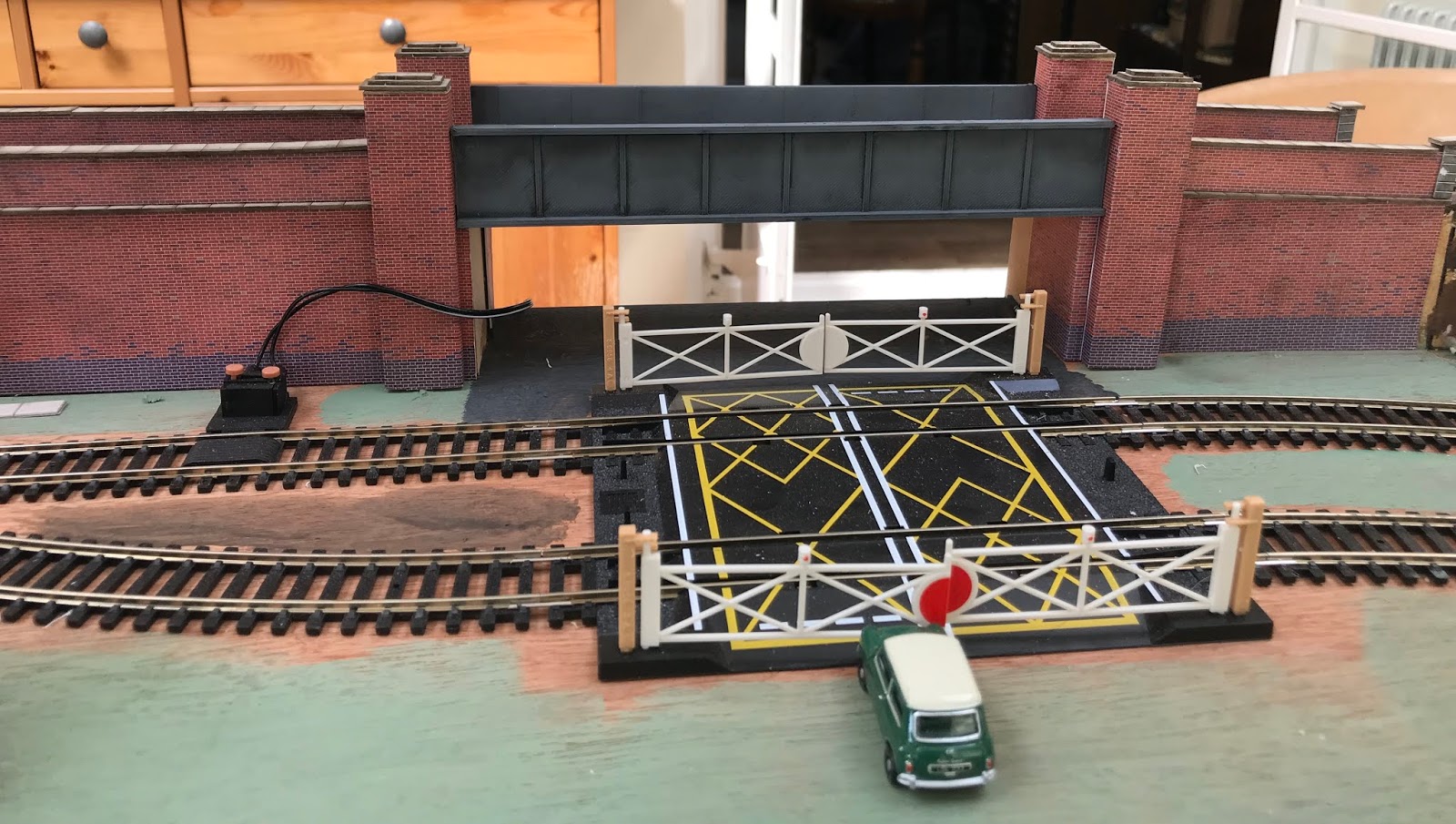
These are simple card construction. The retaining walls are about 7mm thick and made from two layers of 3mm card and between two layers of brickwork card (Metcalf again). They are actually from the platform kit

I applied the red brick to the main walls first and then added the abutments.

Prototype Abutment
These are made from more MDF. I was going to 3D print them but MDF was quicker. This was a card prototype. You can see the L-shape, the shorter part sitting facing towards the track.

The retaining walls were glued to a strip of stone capping from another kit and the glued in place with the capping overhanging the retaining wall. I thought this added depth and gave it a more authentic look. They were capped off with more stone and one side I went for a slopping finish and the other has a stone end pillar.

The end result is quite pleasing and once again shows that model-making isn't as difficult as it might look. I'm still learning better ways of doing things, but as that say, this is my model railway and the only person I really need to please is myself.

Monday, August 19, 2019

A 3D printer? I can't see the point of one myself!

Well actually I can! It's a pain sometimes, but a 3D printer is a real bonus when it comes to developing my model railway. Originally I bought one (Creality Ender 3) because I wanted to explore the world of 3D printing. I had an idea and a 3D printer was an obvious part of the solution to the problem I was trying to solve.

I started to play with some design ideas for the workshop and then when the model railway began to take shape it really came into its own. I've printed parts for models (doors and roof vents for example), small items (milk churns and oil drums) and trackside fencing. I've also printed a church, chimney pots, stove pipes, bridge sections and garden sheds. Quite a collection.

Some I've designed myself, some I've downloaded from thingiverse. Here's a little gallery of some of the things I've printed.
Chute

Stove pipe and roof vents for disused carriage


Country Church

Chimney stack and doors. 

Oil drums and milk churns

Saturday, August 17, 2019

Small Factory Unit Build

When I printed the church there was a large piece of waste from the the supporting structure the 3D printer produces to support the overhanging parts of the print.

Initially it was head for the recycling bin but then I thought I must be able to do something with it. So it sat around for a while and then I thought about Turing into a building of some sort. I settled on a factory and began to work out what to do.

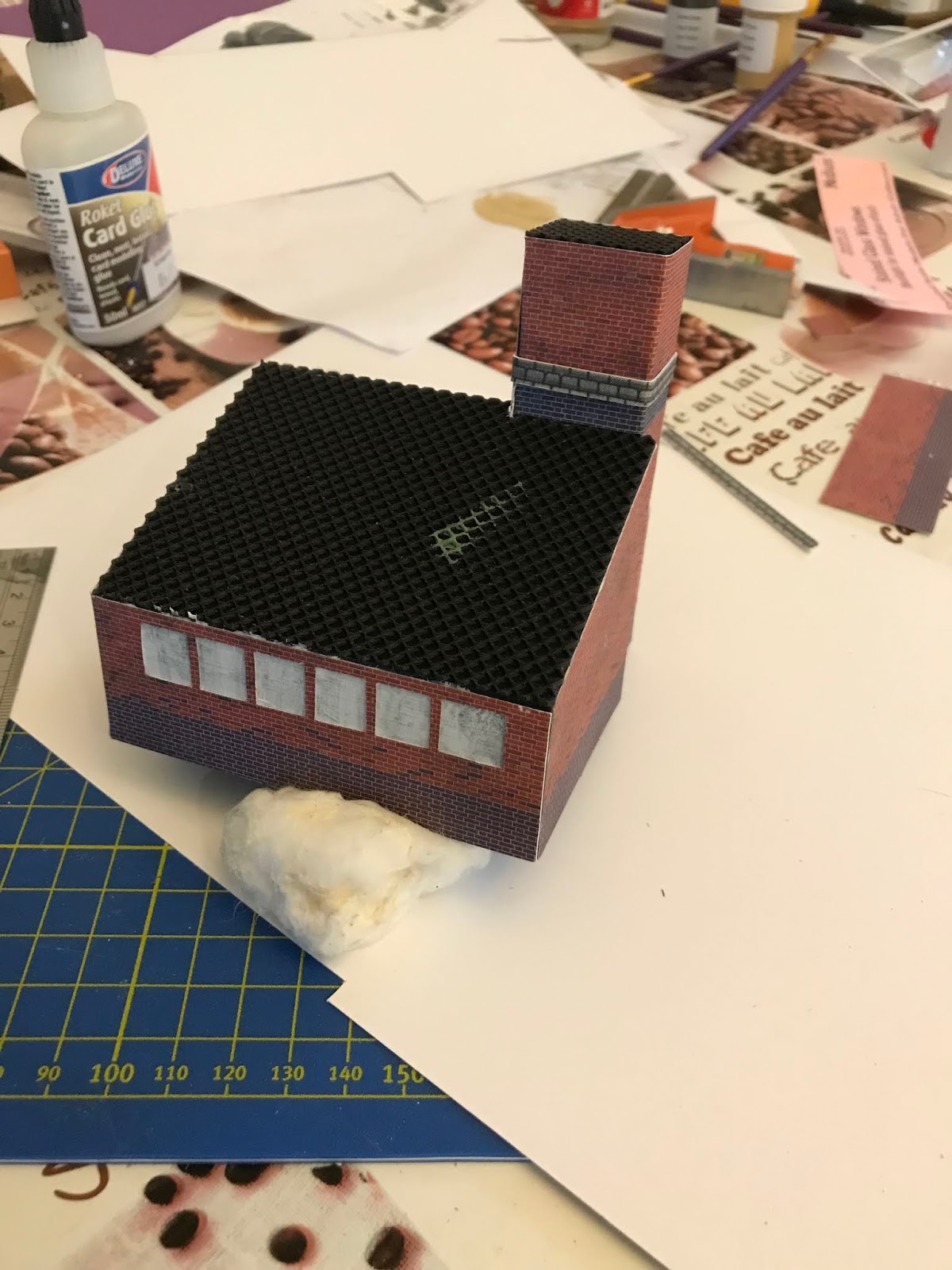
The first thing to do was to glue the two pieces together to give the basic shape of a building with a chimney.

Most of the factories I remember from my childhood had whitewashed windows. To make these I decided to paint the window area quite roughly before adding the walls with window cutouts.

I used some Metcalf red brick card and wrapped the building. On the chimney I made a layer of engineering brick and then overlaid the join with some roof material that came with the brick card.
A factory obviously needs doors and a roof. I'd bought the rusty corrugated panels and roof lights already because I wanted to use them on the aggregates works. On that build I used superglue but it wasn't the easiest way to glue them place (although they are fine). This time I tried epoxy resin and that has worked quite well and it has the advantage that you don't accidentally end up sticking your fingers together!

A bit more 3D printing and we had the chimney top and some doors.

To finish off I added some barge boards and some guttering and a downpipe. A little more weathering and this is how a waste piece of plastic became a factory.