Showing posts with label Model Railway. Show all posts

Saturday, April 04, 2020

Making an oil storage tank for the model railway

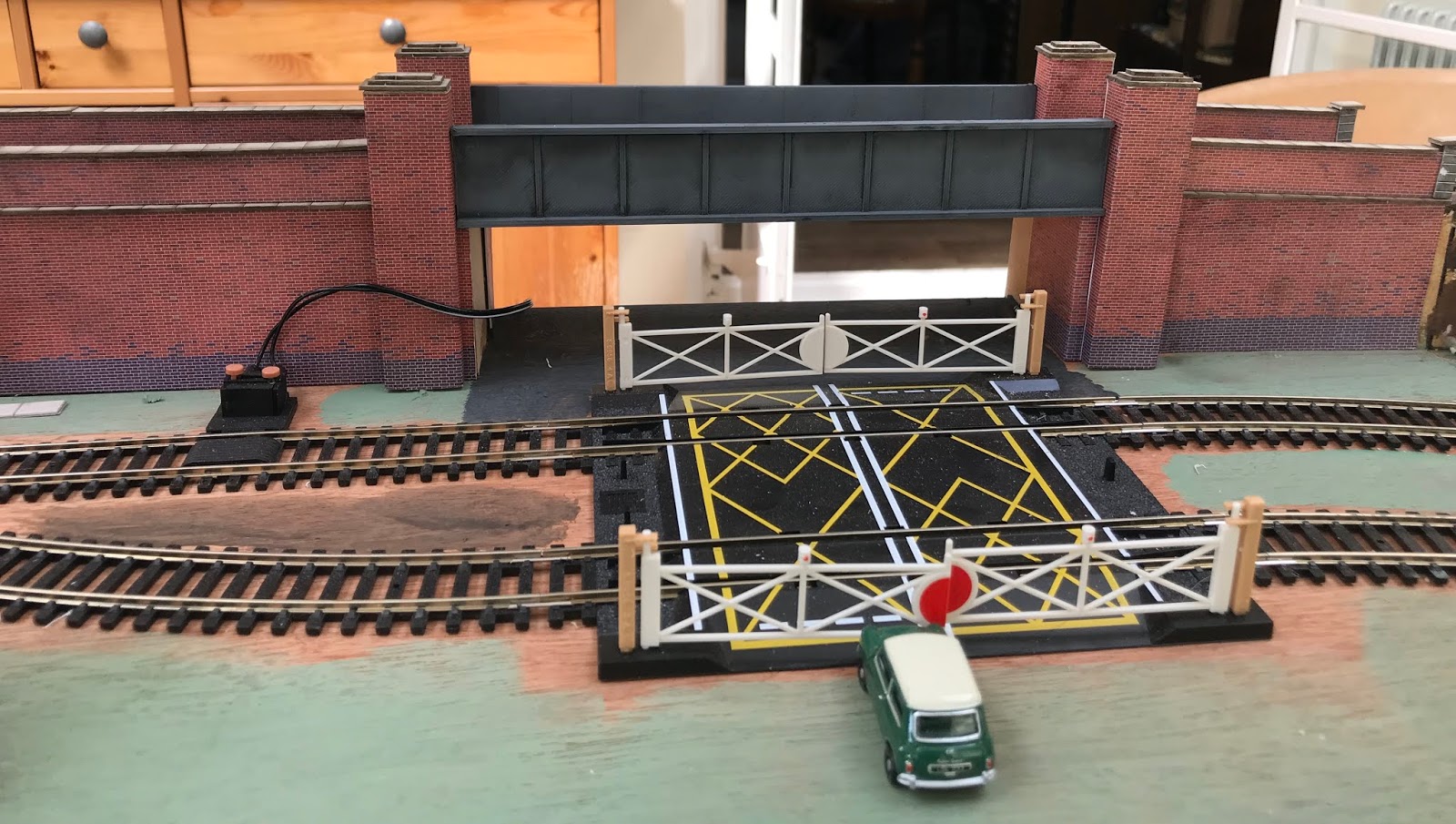
I'm building a small layout that I hope I'll be able to put in the car and take on holiday for my grandsons to have some fun shunting wagons. The layout is an industrial type of scene and I've done some posts about building arches etc for it.

I decided I'd have a go a making a diesel storage tank and maybe set up some sort of fuelling rig. I could buy a kit but I have a 3D printer and this seemed like a reasonable project to tackle with it.

The first step is design and I used Tinkercad for that. I'd love to get to grips with its big brother Fusion 360, but I'm struggling to get my head around it. So here's the basic design idea I developed.

I then decided to change the domes for something that looked like a flange with bolts. ! also decided to add domed ends to the tank because I thought that would look better than just flat ends.

Now I could print it in one go as it is, and I might still give that a go. But there would be a lot of waste material building a support structure under the tank. So I decided to break it down into individual parts and print the components instead. It took a bit of sorting out and I try wisely did the work on a copy of the design and not the original in case I messed it all up! Here's the component parts design.

You can see the new flanges. There are also a couple of tubes that were meant to go in holes in the top of the cylinder to raise the flanges up but they turned out to be too long or the holes weren't deep enough!

This design file then needs to be passed through a piece of software to prepare it for the printer and away we go. It took 3 or 4 hours to print and then it was a matter of assembling the parts after trimming off the waste PLA from the printing process.

This is what out looked like after assembly and then when it has been primed and painted. I still need to decided where on the layout it will go and then whether to build some sort of platform for it or maybe a wall around. And it need some pipes or other equipment to give it a bit more life.

The paints used were a standard primer (bought from Halfords)  and some matt black Humbrol paint, probably some sort of enamel, but I'm not quite sure.

Monday, March 30, 2020

Railway Arches: Part 2

Well I finished off the arches sooner than I anticipated. I guess sometimes you just get caught up in the making and forget how long you've spent being socially distant from everyone!

Here's the finished arches on the baseboard.

There are eight in total spanning almost 1220mm. I had to fashion some small end walls from brick paper and card to fill the gaps at other end. I had thought of fitting the  board the length of the arches or leaving a bigger gap at one end. But in the end I decided to put it centrally.

Once in position I began to think about the kind of fence I wanted to separate the arches form the railway. I thought about a few possibilities, the main consideration being not to obscure the arches too much. Chain link would do the job, but I thought some concrete panels might look quite good.

Here's how I made my test piece. I used 2mm thick card and cut it into 8mm strips for the panels and 3 mm strips for the posts.

Initially I thought I'd make the fence posts long enough to fit into predrilled holes in the base board. I might regret having changed my mind on that.

The four 8mm strips were set out and carefully aligned at one edge. On one strip I marked out 25mm intervals and using a small square carefully glued the posts to all the strips working my way along.

When I'd finished one side it looked like this.

The next job was to turn the section over and glue more 3mm strips in line with those on this side to give the look of a panel sitting in th groove fo a concrete post.

The next task will be to paint and weather it. I might even add some graffiti for realism!

In 00 gauge it's 8 ft tall. The 25mm spacing of the posts was for convenience of making out. I didn't think 1mm would impact the sense of scale too much! 

I put this test piece in position in front of the arches and it's a good height. It doesn't obscure too much of the arch detail but it still gives a realistic representation of a fence.

Although a bit tedious to do, cutting the 8mm strips makes it look like those fences where the concrete panels slide in. Time to make some more.


Saturday, March 28, 2020

Railway arches: Part 1

I've got an idea for a small, industrial looking layout to replace the winter scene I created for Christmas. I want to include a row of arches, the kind with businesses under them. I had a look around at the kits available and decided to give Superquick a try. They do a set of embankment arches that looked like they would do the job nicely.

Now it's nothing personal, but I'm not a fan of Superquick. I find the instructions lacking in detail at crucial points in the build. Having tried to assemble one set I couldn't make them fit properly and the frustration was building. I decided on a different approach.

I cut a piece of 6mm ply for a backing for the arches. You'll see that in the photos of the build process.

With the ply back cut, I separated the main arch structure from the sheet, cutting away the assembly tabs. They come in pairs and can be separated into two single arches.

Turning them over I added two layers of 2mm card. To shape it around the arch I cut small pieces of card and glued them in place around the arch.


 I added more card at the edges and in the middle. This sets the arch 4mm away from the backing sheet.

Once dry enough to handle, the arches were glued to the ply board, taking care to line them up properly.


A good square edge to the ply is important, otherwise there is a chance that the arches will be out of square and as you progress from one edge to the other the error will get more pronounced.


The inside detail of the arch can be selected from either a plain bricked insert, a brick wall with a pair of doors or a business front. The doors are glued to the insert from the back and some 1mm card is used to give some support to the structure.

A sharp knife was used to follow the curved edge of the arch when trimming back the card.

The insert was then glued into position within the arch. The idea was to give some depth to the arch.

Here are the first four arches assembled. There will be eight arches in total with a single track running above them. Butresses and a small retaining wall will be added.


Thursday, February 20, 2020

Dirt and Grime

I've been working on my wagons o try and make them look a little less like toys and a little more more like realistic, weathered rolling stock. I've used pastels, fixative spray, homemade acrylic washes and decal fix.

The pastels are scraped with a blade, or in my case an old teaspoon, to make weathering type powders. I've used brown, black, white and whatever the one is that looks like rust. Colours are not my strong point.

On these two I used a dry brushing technique to apply the pastels onto the surface that had been sprayed with fixative. I think I overdid the one on the left, but it definitely looks weathered!

I found that when I tried the same technique of an open plank wagon, the dry brushing over the fixative seemed to rub the original decals away. You can see that on the grey wagon in the photo.

Again, I'm not bothered because I'm sure there were wagons that got this filthy and distressed with age, but I changed my approach ofter this.

The challenge is to do little and add rather than have to try and brush out too much. That's why I thought I'd try using decal fix, applying it to the areas I wanted to weather. That worked ok, but I need more practice.

Here's a picture of some of the wagons I did this way. The first thing I did was to paint them all over with a black wash that I let almost fully dry before adding the powdered pastels. I then used a stiff dry brush to work the colours into the surfaces.

If you look closely you'll see an area on the one of the right that doesn't seem to have any colour added to it. Perhaps it just got washed by someone!

I quite like the dull effect and the addition of some white on these.The rust on the one on the left might be a bit heavy, but I could brush this in a bit more because these colours aren't fixed as yet. I might spray them with a clear matt varnish, but if I do that the effect will be permanent. As it stands, I think a good scrub in warm soapy water would clean most of the dirt and grime away.


Here are the last three I've done. I'm particular fond of the rust and dirt on the running board.

Overall I think the dry brushing black wash and decal fix worked the best and it was certainly easy to clean off if I wanted to undo something. Having said that there was one moment when I had got the roof as I wanted it, only to mess it up by accident doing the side and then having to clean it and reapply the finish.

So pro's and con's to each technique.

Thursday, November 07, 2019

It's all about the details

A quick update on the model railway.

I need to take a long hard look at the track and decide what to change in order to make it easy to separate the layout into three sections for storage. Eventually We are going to want the dining table back, so I can't put ogg cutting the track at the joins too much longer.

The biggest challenge is around the back-to-back points that allow a train to move from one loop the other other. As you can see form this early photo of the layout there are a lot of points in a small area and they are very close to the joins.

I think I will have to take out one pair of points and put the crossover more central to the centre panel.

Taking up the track isn't a problem, it's just annoying, but it needs to happen. There's also the issue of how to make the electrical connections once the track has been cut. I have a plan but getting around to adding panel mount connector and soldering up plugs hasn't inspired me just yet. Maybe I'll make uo some connectors and that will get me going.

A lot has changed since this photo was taken. Here are some pictures of the layout as it is now.


We have some working street lights and more to add around the market square and in front of the station. Picnic tables and flower borders are also going in.

Tuesday, October 01, 2019

Prototype control panel

This is in no way the final design or finished item, but I thought I'd do a short post about my prototype control panel.

As you can see it has a lot of switches and currently 3 controllers with room for a fourth. The basic plan was to be able to control up to three trains at a time on three different parts of the layout. It's all DC rather than DCC. In simple terms DC controls the track, DCC controls the locomotives.

To allow a train to move from one track to another you need to be able to pass control of each track to the cab (the bit with the directional switch and control knob). Each track is wired through 3 switches allowing the user to select which cab controls what track or tracks.

The system isn't foolproof and because some track is shared by the outer loop and the East/West beaches it requires some form of isolation to prevent trains on different tracks running when they they shouldn't. The points provide some isolation, but not enough, so I've installed a switch to isolate part of the outer loop where a train can be parked while another uses the shred piece of track. At least that's the idea, I haven't tested that bit yet because it requires me to cut the track and I haven't been brave enough to do that yet!

Initially I thought I was going to need four switches per block of track, but it turned out I only needed three so the fourth switch is redundant part from the one that will isolate the outer loop from the shared track.

I've left space for point control on the right hand side. This will be a series of momentary switches to shift the points.

Monday, September 16, 2019

Fences

Building our model railway is about experimenting and learning. We've gone for a mixture of building styles and types with different finishes, as indeed you would find in any town with a bit of history to it.

The same can be said of fences. It would be rather flat and boring to have the same sort of fence all over the layout. So far we have three types of fence. Two have been 3D printed and one is completely handmade. One of the 3D printed fences runs along the side of the track one the east side of the layout. You can see some of it in this photograph:

The ,layout is more developed now and this fence encloses the green area. It even has a couple of gates in it for access.

The handmade fence is constructed from matchsticks and floristry wire. It's all high tech stuff here! The matchsticks need to have 1mm holes drilled through them to take the wire that is painstakingly threaded through. 3mm holes drilled in the base board at 25mm centres locate the sticks. I'll add a dab of PVA later to secure them, but they are a reasonably snug fit, so nu rush.

I've tried a couple of ways to weather them. A mixture of a burnt umber acrylic wash and the more recent batch that are currently drying have been dipped in a wood stain.

To drill the holes I lined up a whole bunch of matchsticks on a piece of double-sided tape in a small jig made from off-cuts of ply. Then a steady hand with a hand-drill and taking my time I made the holes. Some of the matchstick split, but that was okay because they could still be used and they gave the fence a more aged looked with little bits broken away.

The matchsticks I used came without the live end. you buy them for modelling purposes this way in a big bag of about 1000.

Friday, September 06, 2019

Scenery: 2

Having more or less completed the scenery on one side of the layout, it's time to turn my attention to another corner. Given that we have the inclines, there's an opportunity to experiment with different ways of disguising the hardboard support structure.

Around the bridge I simple used brick and stone effect card to give a walled finish. I've also painted the grainy side of the exposed hardboard grey to see if that looks okay. On the inside of the incline I'll use brick card again, but on the other outside edge I wanted to try and sculpt a rock type look.

Here's what I did.

First of all I used a Woodland Scenics rock mould to cast some rock face material. I've used this above my tunnel entrances on another corner of the layout. Then I used Sculptamold to provide a bed for these rocks and to fill in the gaps. As it dried I poked it with my fingers, a small paintbrush and a scalpel to blend it all together.

You can see one of the rock mould pieces picked out in grey (and there's a pile of them in the bottom right-hand corner of the photo too(. Once it had all dried I added grey by dabbing spots on the surface and then brushing out unevenly over the surface allowing bits of white to remain. I then used a black wash over the top f that.

The end result is quite a pleasing effect and the sculptamold worked really well. As it dries you can wet your hand and smooth and shape the surface. On my hillside above the tunnel I kept going like this until I got the shape and finish I was looking for before I applied static grass.
 I thought the electrics and running the trains was going to be the most interesting part of building the model railway, but experimenting with the scenery has been a lot of fun and a challenge too.

Friday, August 23, 2019

Trying my hand at scenery

It's far from finished but I thought I'd document my first attempt at doing some scenery for the model railway. The thing is I was never "good" at art at school, mainly because of my lack of colour sight always making me think I couldn't "do" art. But that that doesn't stop one being creative and although my art teacher could not comprehend the colour issue, I've found other ways to be creative that don't involve distinguishing red from green or blue from purple.

Adding scenery to the layout was always part of the deal. It began with some of the buildings about which I have already written. But what about grass and trees etc? Well, here's the progress so far.

It still need more grass adding, but I'm waiting for a better state grass applicator to arrive. For those who don't know, static grass doesn't refer to a lack of movement but the way it is applied. It uses a static charge to make the grass fibres stand up. You can do this with a plastic bottle, but that doesn't seem to have worked particularly well.

I've used a process I saw in a video by Kathy Millat, although the layering spray I bought was the same product it was not in the spray can but an aspirating type bottle which may have made a bit of a difference. I also used a puffer bottle rather than the electrostatic applicator which I have now ordered to try on the next area.

The trees came ready made from Model Scenery Supplies, as did much of the static grass. I built the embankment from PIR insulation board (Cellotex in my case). It's easy to carve and shape using a sharp kitchen knife.

Small gaps were filled with decorators caulk. On reflection a more rigid filler might have been a better choice but this was what I had lying around in the workshop.

Once that was all dry we covered it with strips newspaper and used standard PVA glue to fix it all in place.


 I wasn't too worried about making it super smooth because that wasn't the finish I wanted. I wanted something uneven and less cultivated looking.

Once dry it got a coat of poster paint to give a soil like base. Even at this stage it was looking okay although there were a few cracks that needed sorting out. I painted a few area white and grey using acrylics and washed them with a black wash to make bits of chalk face show through.

Some got covered up with grass when I forgot to avoid them with the base glue and layering spray!

Which brings me to the grass application process. As I mentioned, I didn't;t find the puffer bottle that easy to use. I ended up spraying grass fibres all over the place. That's not a big problem, but I did feel that it made getting the stuff in the right place a bit of a chore. I also found that the base glue went off very quickly. Perhaps the painted paper absorbed it too quickly and Male a base coat of PVA to seal the surface first might have helped.

In the end I'm quite pleased with how it's turning out. Having added some line-side fencing and a few tress has made this corner of the layout really come to life.


Tuesday, August 20, 2019

Building a bridge

 Sadly I didn't take any pictures of the process of building the bridge. A bit of an oversight given that my plan was to document the process!

Prototype bridge
It started with a simple prototype made from from 6mm MDF. Nothing more that a couple of supports and the flat bed for the track.

Once I'd figured out the height I built the bridge and added the side sections, all made from MDF.

The girders were 3D printed, primed in grey and then painted with a black acrylic wash to make them grimy.

With the girders superglued in place I set about building the walls.

These are simple card construction. The retaining walls are about 7mm thick and made from two layers of 3mm card and between two layers of brickwork card (Metcalf again). They are actually from the platform kit

I applied the red brick to the main walls first and then added the abutments.

Prototype Abutment
These are made from more MDF. I was going to 3D print them but MDF was quicker. This was a card prototype. You can see the L-shape, the shorter part sitting facing towards the track.

The retaining walls were glued to a strip of stone capping from another kit and the glued in place with the capping overhanging the retaining wall. I thought this added depth and gave it a more authentic look. They were capped off with more stone and one side I went for a slopping finish and the other has a stone end pillar.

The end result is quite pleasing and once again shows that model-making isn't as difficult as it might look. I'm still learning better ways of doing things, but as that say, this is my model railway and the only person I really need to please is myself.

Monday, August 19, 2019

A 3D printer? I can't see the point of one myself!

Well actually I can! It's a pain sometimes, but a 3D printer is a real bonus when it comes to developing my model railway. Originally I bought one (Creality Ender 3) because I wanted to explore the world of 3D printing. I had an idea and a 3D printer was an obvious part of the solution to the problem I was trying to solve.

I started to play with some design ideas for the workshop and then when the model railway began to take shape it really came into its own. I've printed parts for models (doors and roof vents for example), small items (milk churns and oil drums) and trackside fencing. I've also printed a church, chimney pots, stove pipes, bridge sections and garden sheds. Quite a collection.

Some I've designed myself, some I've downloaded from thingiverse. Here's a little gallery of some of the things I've printed.
Chute

Stove pipe and roof vents for disused carriage


Country Church

Chimney stack and doors. 

Oil drums and milk churns

Saturday, August 17, 2019

Small Factory Unit Build

When I printed the church there was a large piece of waste from the the supporting structure the 3D printer produces to support the overhanging parts of the print.

Initially it was head for the recycling bin but then I thought I must be able to do something with it. So it sat around for a while and then I thought about Turing into a building of some sort. I settled on a factory and began to work out what to do.

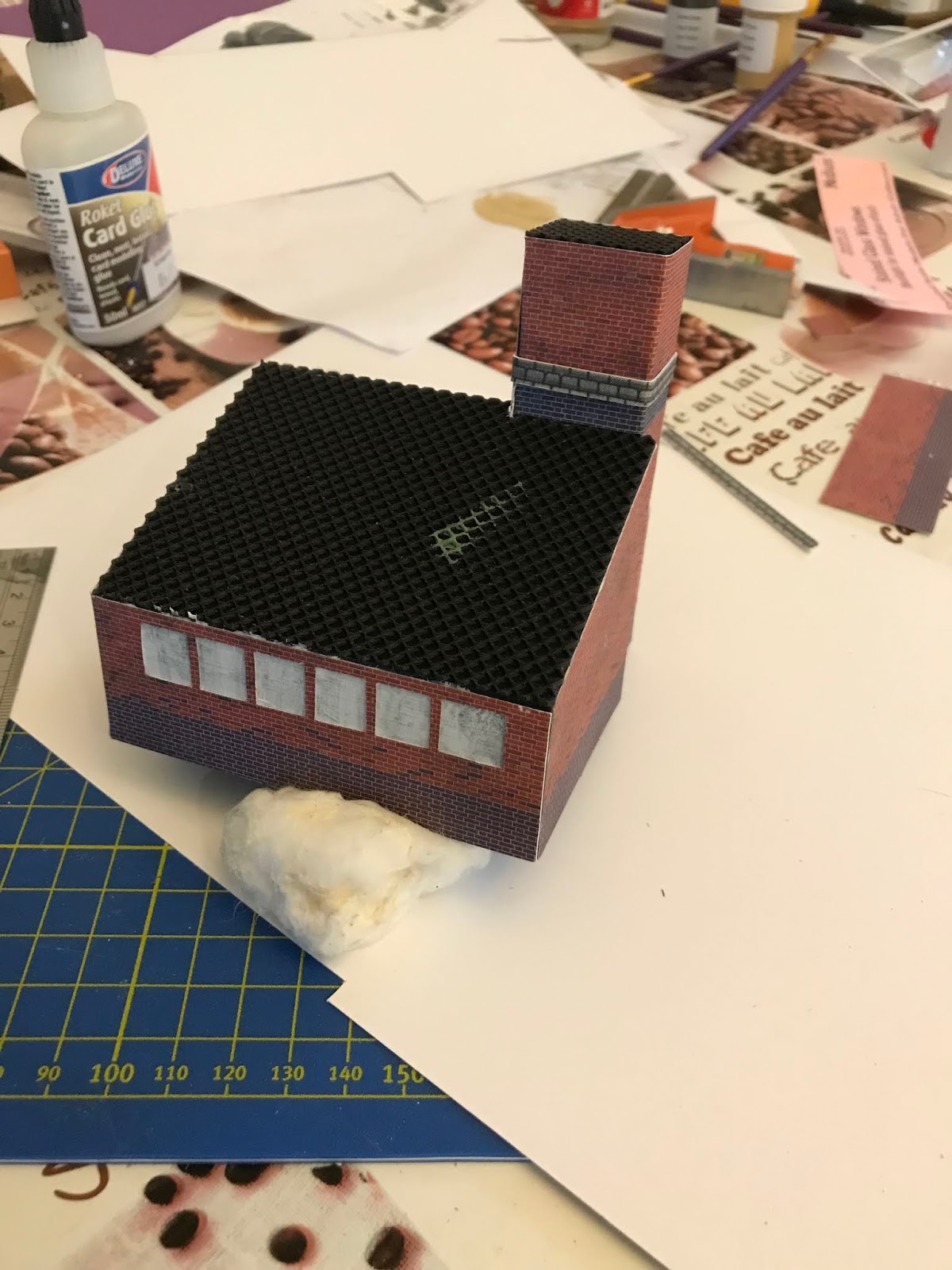
The first thing to do was to glue the two pieces together to give the basic shape of a building with a chimney.

Most of the factories I remember from my childhood had whitewashed windows. To make these I decided to paint the window area quite roughly before adding the walls with window cutouts.

I used some Metcalf red brick card and wrapped the building. On the chimney I made a layer of engineering brick and then overlaid the join with some roof material that came with the brick card.
A factory obviously needs doors and a roof. I'd bought the rusty corrugated panels and roof lights already because I wanted to use them on the aggregates works. On that build I used superglue but it wasn't the easiest way to glue them place (although they are fine). This time I tried epoxy resin and that has worked quite well and it has the advantage that you don't accidentally end up sticking your fingers together!

A bit more 3D printing and we had the chimney top and some doors.

To finish off I added some barge boards and some guttering and a downpipe. A little more weathering and this is how a waste piece of plastic became a factory.


Friday, August 16, 2019

Finishing off the aggregates works

So  the rusty metal panels arrived and have been fitted along with a roof to complete the building that has become an aggregates depot.

I did say that we were adding things that connected with out life and this has been named after our two grandsons Tobias and Ben.

I might add a second sign above the double doors, but apart from that it's finished.

I need to develop the area around it now-paint the base and texture it, add a few bits and pieces like some ladders and maybe some scrap.

We shall have to wait and see.

The next building project is to make use of the support structure left over from the 3D church print. It seems a waste to throw it away, so it's going to be turned into a small factory unit of some kind.

I'll use more of the corrugated panel for the roof and add some skylights. I'll print a chimney top and some doors to give it some depth.

In between finishing off the works I made a start on the platform for the station. I've ordered a station kit, but it will need a bit of adapting. Either that or a complete rethink if the station position which in turn might make some changes needed to the layout.

We've also had two trains running at a time which is quite exciting. I'm yet to really get to grips with how to wire the whole thing, but I've got a couple of controllers and each is connected to a loop of the track so we cans ee them running.

Here's a short video of it all running. It's oddly satisfying to see these two small trains going round and round in opposite directions!